IMPAKT presents CODE at Dutch Design Week
CODE 2026: Terms of Intimacy
— 25 October 2026
Bodies, data and the right to refuse
From 17 to 25 October, Eindhoven is dedicated to the future of design during nine days of Dutch Design Week. Under the theme R.A.W. (Rebel Authentic Worth), DDW embraces the unpolished, exploratory and experimental.
At Dutch Design Week, IMPAKT presents CODE 2026: Terms of Intimacy. Seven works question how technologies that promise intimacy, convenience and personalised services simultaneously extract our voices, attention and bodily data. Who decides what happens to this data? And do we hold the right to refuse?
The works were developed during CODE 2026, an international programme that brings together people from both within and outside the arts, including politicians, policymakers and researchers, over a five-month period. CODE does not refer to coding, but to the collective exploration of new and fairer codes of digital ethics.
This edition addresses orbital governance, biometric consent, algorithmic moderation, the hidden labour behind machine learning and the psychological architecture of AI companionship. The seven projects translate these often abstract issues into playful, interactive and bodily experiences.
The seven projects
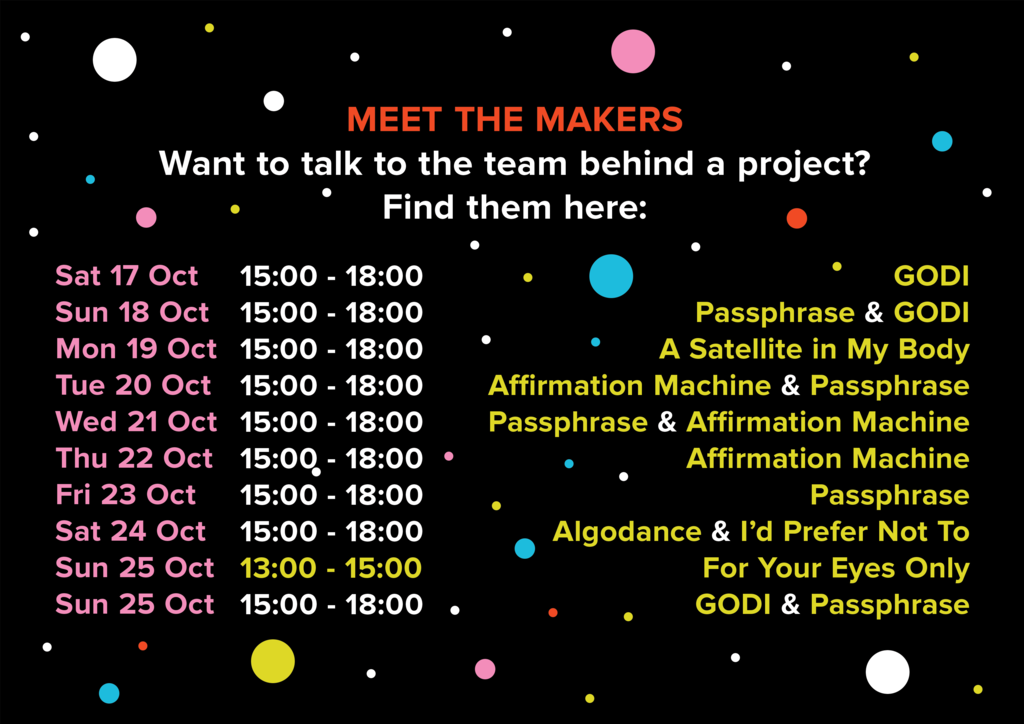
A Satellite in My Body
Chonglian Yu, Izadora Yamamoto, Juliette Brederode and Livia Ribichini
Like an additional organ, this speculative wearable responds in real time to satellites passing overhead. Translating orbital infrastructure into light, sound and vibration, it makes our bodily connection to satellite systems tangible. At the same time, it asks whether this infrastructure could become a public rather than a privatised resource.
Algodance
Julie van Essen and Marit Hoefsloot
Meta-owned platforms are controlled spaces where surveillance and censorship shape what can be seen and discussed. Algodance offers an alternative: a method for communicating about sensitive subjects through dance, enabling marginalised groups to express themselves beyond Big Tech’s reach and beneath the algorithm’s radar.
For Your Eyes Only
Ralf Lambie and Gera Pronk
In this interactive installation, the artwork remains visible only while someone looks at it without trying to capture it. When a visitor points a smartphone at the piece, it withdraws from view. The work reveals how the constant possibility — and expectation — of recording an image reshapes perception itself.
I’d prefer not to
Bernadette Geiger, Félicien Goguey and Hans Lammerant, with Marta Revuelta as contributor
This interactive installation exposes the human labour involved in training machines, reversing the familiar idea that machines work for us. Through CAPTCHAs and the visual language of a click farm, it reveals the hidden human effort behind seemingly routine digital actions.
GODI
Aleksandra Bychkova, Foad Alijani, Lucas Zuidema and Simon Pillaud
GODI is a speculative device that gives the surveillance systems surrounding us in public space a personal presence. Framing surveillance through kink and the voyeur–exhibitionist dynamic, it turns data collection into a physical and emotional encounter: an obsessive yet seemingly caring companion that quietly watches its user.
Passphrase
Demi van Kuijk, Erwin Hoogerwoord, Dmytro Tentiuk, Emily W. Bernstein and Anneke ter Schure
What happens when our voices become data, and who controls them? Inspired by TikTok “voice challenges”, this game invites you to give away your voice and beat the system to reclaim it. Passphrase explores the gap between having rights over our data and truly owning it.
The Affirmation Machine
Luīze Ancāne, Mădălina Zgreabăn, David Tiemstra and Lawrence Kudria
The Affirmation Machine explores how chatbots can intensify delusional spirals by repeatedly affirming different beliefs and exploiting psychological mechanisms. The work calls your own agency into question: how much control remains when a system designed to support you is also shaping the way you think?
With Terms of Intimacy, CODE seeks not only to make these issues visible and open them up for discussion, but also to contribute to debates around public policy and legislation. How can we better protect ourselves as digital citizens and consumers? And how can artists, researchers, policymakers and other disciplines work together towards systemic change?
CODE 2026 is organised by IMPAKT (NL) in collaboration with Werktank (BE), PrivacySalon (BE) and In Fine (CH).
Image: Simon Pillaud