On Topic: Together in the Slop
Memes, Machines, and the Search for Meaning Online
Recently, Plaster magazine published an article by Günseli Yalcinkaya titled “Digital Data or Futurist slop? An investigation into brainrot as art”, a topic closely aligned with our ongoing Crit Club: Meme Debates exhibition at IMPAKT. Part 1 of the exhibition explored the question “Do institutions need memes or do memes need institutions?”, sparking debate on the relevance of brainrot memes in artistic institutions. Although the idea of a MoMA brainrot exhibition was mentioned simply in jest during the first Crit Club debate, Yalcinkaya makes an interesting suggestion of brainrot as an artistic movement, albeit one that positions itself outside of the institution. She makes her case by drawing a historical and political parallel between brainrot and two 20th century artistic movements, Italian Futurism and Dadaism.
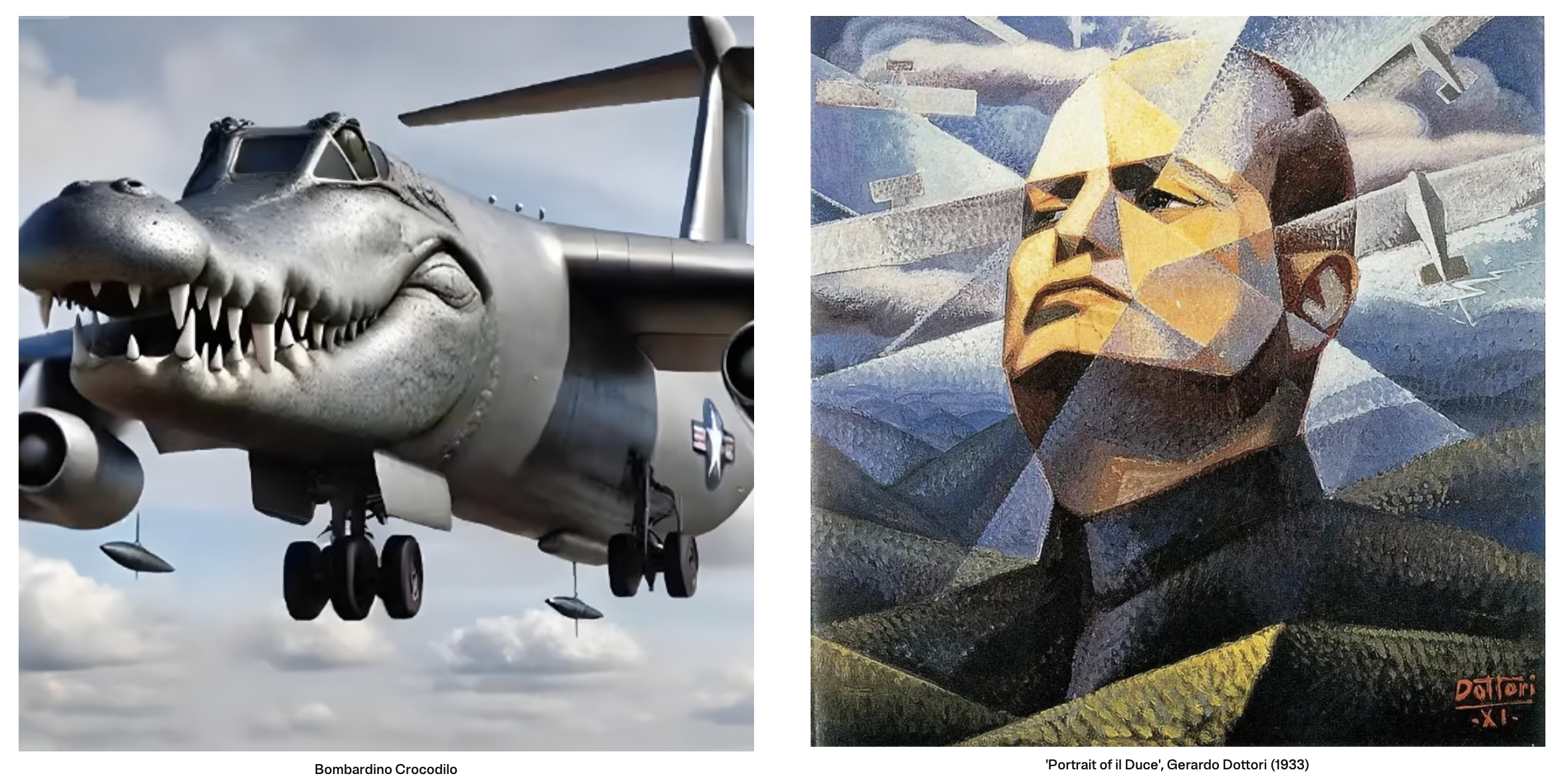
For Futurism, Yalcinkaya notes the visual similarities between Italian Brainrot characters, such as Bombardino Cocodrilo with Gerardo Dottori’s Portrait of il Duce, apparent through their mutual sporadic, surrealist, yet still somewhat militaristic aesthetics. Additionally, the techno-accelerationist proclivities of both echo deeper, darker historical legacies of techno-fascist aesthetics. This reading casts quite a dark, politically charged shadow over what might otherwise appear as random, humorous, AI- generated absurdities. It also reminds us of the biased nature of AI technology, despite its supposed neutrality and oracle-esque facade.
However, rather than condemning brainrot as subliminal fascist, Yalcinkaya offers an alternative artistic antecedent for the meme genre, namely, Dadaism. This comparison is more intuitive, with both genres intentionally embracing nonsense, parody, and being stylistically stream-of-consciousness. Through this comparison, brainrot redeems itself as a Dadaist-inspired critique of rational, ordered, and structured society, thus, as a critical tool engaging the masses through the humorous aid of meme logic.
Part 2 of our ongoing Crit Club exhibition asks “Do memes unite or divide?”, a question that also underpins Yalcinkaya’s essay as she weighs the opposing political inheritances of brainrot memes: techno-fascism vs. satirical subversiveness. Leaning into the latter optimistic interpretation, Yalcinkaya references Al Hassan Elwan’s essay “The meme: What is dead may never die” by highlighting his argument that “AI slop alienates us from each other, whereas brainrot brings us together.” Elwan distinguishes AI slop as shallow, high-volume content designed to prioritize doomscrolling and individual consumption. Brainrot, on the other hand, is praised by Elwan as the confirmation of human presence in the algorithmic stream of slop, evidenced by it’s integration into meme culture.
As mentioned during the second Crit Club debate, brainrot memes are actively building lore. The concept and humorous understanding of, say, Ballerina Cappuccina is progressively built user to user through collective online engagement and references. This is our ‘sitting around the bonfire’ moment in which we construct this meme vernacular, our modern mythology, the meaning of which lies in its shared understanding and participatory nature, incomprehensible to the non-sentient.
Now, I’m not entirely convinced that Tung Tung Tung Sahur will lead the charge towards digital solidarity in the fight against the shallowness of AI slop, though it certainly is worth a discussion… Luckily, there’s still a few more days to catch part 2 of the Crit Club: Meme Debates exhibition, featuring a video installation of the debate “Do memes unite or divide?” with Marc Tuters, Idil Galip, Riad Salameh, and Pete Fung, moderated by Ilga Minjon and paired with a boxing performance by Eastside Boxing Academy. The exhibition is accompanied by a rhetorical analysis by Arne Willée and post-match interviews with the debaters. Which argument is most convincing? Come cast your vote at IMPAKT before the exhibition closing this Sunday 29 June!
You can read Günseli Yalcinkaya article here
And Al Hassan Elwan’s article here
Meme by Melle Nieling (part of our meme maker residency during Crit Club)
On Topic written by Mita Medri